Re: Facebook buys Oculus VR for 2 billion + M$ gives out sou
http://www.engadget.com/2014/03/25/nvidia-pascal/
NVIDIA's next-generation GPU is called Pascal, and it's smaller, faster and more efficient
BY SEAN BUCKLEY @SEANICCUS MARCH 25TH, 2014 AT 1:13PM ET
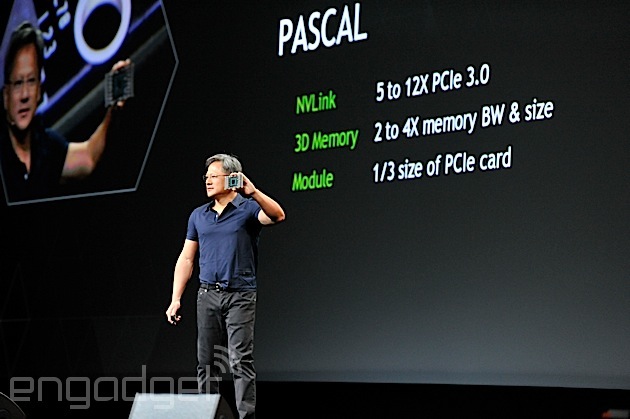
What comes after Fermi, Kepler and Maxwell? Pascal, according to NVIDIA CEO Jen-Hsun Huang. That's the name of the company's next-generation GPU, and Huang says it'll be smaller, faster and more efficient, naturally. "As we compute more, we have to move more data around," he said, speaking at NVIDIA's GPU technology conference in San Jose today. "It's the data bottleneck." He's talking about how the speed at which data is exchanged between the CPU and GPU limits the processor's ability to perform. He's also talking about how NVIDIA hopes to solve the issue, introducing NVLink, a chip-to-chip communication technology (a new socket) that promises to outpace PCIe communication speeds by a factor of five (but up to 12). The company says the PCIe standard probably isn't going away, but is confident that its dedicated GPU socket will allow it to leapfrog existing bottlenecks. Although NVLink seems to be designed to speed up GPU and CPU communication, Huang says it also improves data transfer between GPUs -- meaning that graphics cards linked in SLI could see a performance boost, too.
Of course, speed, power and efficiency usually come at the price of physical size. NVIDIA says it's working on that. "The GPU is already the biggest chip in the world," Huang says. "The interface is already extremely wide. How do we solve that problem?" His answer is 3D memory packaging. "We're going to, for the first time, build chips on top of other chips." By using a chip-on-wafer 3D integration, NVIDIA can build smaller GPUs that are four times as energy efficient as today's chips. The company is also working on other technologies to improve its next-generation GPU, including a unified memory system that will eliminate the need for developers to split resources between CPU and GPU memory. Exciting? Sure, but don't expect to pick up a Pascal-powered laptop any time soon: NVIDIA doesn't plan to ship the GPU until 2016.
its a whopping 3,000 dollars!!!!!!!!!
___________________________
Nvidia:
http://blogs.nvidia.com/blog/2014/03/25/titan-z/
By Justin Walker on March 25, 2014
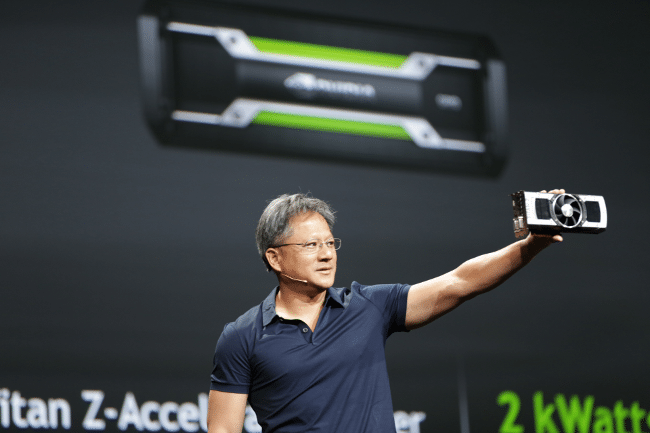
Continuing the TITAN legacy of supercomputer-inspired performance, NVIDIA CEO Jen-Hsun Huang unveiled the GeForce GTX TITAN Z today at our annual GPU Technology Conference.
Built around two Kepler GPUs and 12GB of dedicated frame buffer memory, TITAN Z is engineered for next-generation 5K and multi-monitor gaming.
With two GK110 chips, TITAN Z is powered by a total of 5,760 processing cores, or 2,880 cores per GPU.
“If you’re in desperate need of a supercomputer that you need to fit under your desk, we have just the card for you,” Jen-Hsun said.
GeForce GTX TITAN Z Graphics Card
Unlike traditional dual-GPU cards, Titan Z’s twin GPUs are tuned to run at the same clock speed, and with dynamic power balancing. So neither GPU creates a performance bottleneck.
And that performance is delivered in a card that is cool and quiet, rather than hot and loud. Low-profile components and ducted baseplate channels minimize turbulence and improves acoustic quality.
So if you want to build the ultimate ultra-high definition gaming rig that can harness the power of quad GPUs working in tandem, TITAN Z is the perfect graphics card.
Categories: Corporate, Gaming
- See more at:
http://blogs.nvidia.com/blog/2014/03/25 ... FQuhg.dpuf